
Ask any quality, compliance, or operational team if they manage risk. The answer will almost always be yes, often backed by a register or spreadsheet of identified and categorized risks.
But what actually happens after a risk is documented? Often, not much. Registers are reviewed and scores updated, but most entries just wait for a change to be forced.
This is risk documentation. It is not the same as risk management.
Documenting a risk creates a record of awareness. Managing a risk requires understanding how failures occur, what causes them, what effects they create, and what actions reduce their likelihood or impact.
The distinction matters because the gap between documentation and action is where organizational failures tend to live. A known risk that has been logged but not analyzed, assigned, or mitigated is still a live risk, regardless of what the register says.
Why risk registers often fall short
Risk registers and spreadsheet-based approaches are not without value. They create a shared vocabulary, support audit readiness, and give organizations a starting point for consistent conversations about uncertainty. The issue is not the concept of a register. It is how registers are typically used in practice.
Most registers are built to capture information. A risk is described, assigned a likelihood and impact score, and given an owner. That is often where the structured work stops. The register does not push teams to explore why the risk exists, what specific failure scenarios could cause it to occur, or what an appropriate mitigation response should look like.
As a result, teams often fall into a cycle of maintaining documentation instead of reducing risk. Risks are reviewed, scores are adjusted, and ownership fields are updated, yet the underlying conditions that allow failure to occur rarely change.
What is missing is not awareness, but structure. Organizations need a method that moves them beyond describing risks and into analyzing how failures actually occur.
FMEA: a structured method for analyzing failure
Failure Mode and Effects Analysis (FMEA) is a systematic approach used to identify how a process, product, or system could fail, understand the causes and consequences of those failures, and prioritize action based on their potential impact.
Originally developed in aerospace and defense, FMEA is now widely used across manufacturing, healthcare, service operations, and technology environments. Its value comes from a simple but disciplined way of thinking: before a failure occurs, identify how it could happen, understand what would cause it, and determine the effect if it does.
At its core, FMEA is built around three practical questions:
- What could go wrong? This defines the failure mode, the specific way a process or function could deviate from its intended outcome.
- Why could it go wrong? These are the causes, the upstream conditions, system weaknesses, design limitations, or human factors that make failure possible.
- What happens if it does go wrong? These are the effects, the downstream consequences to the customer, the process, or the organization.
Working through these questions forces a level of analysis that goes far beyond simply listing risks. It requires teams to understand how failures actually occur within their operations.
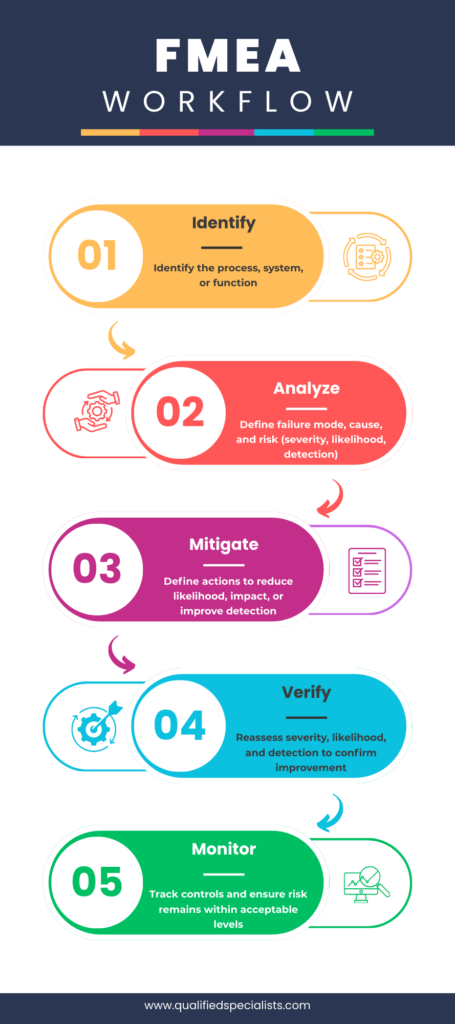
From this analysis, risks can be prioritized using a Risk Priority Number (RPN), which considers severity, likelihood, and detectability. Higher priority items receive focused attention, ensuring that mitigation efforts are directed where they matter most.
What separates FMEA from a traditional risk register is its depth. It does not stop at identifying that a risk exists. It breaks the risk down into failure modes, traces those failures back to their causes, evaluates their impact, and defines actions to reduce exposure.
Where FMEA applies
Although FMEA is often associated with engineering and manufacturing environments, the method itself applies wherever processes are expected to perform reliably and where failure carries meaningful consequences.
In manufacturing, teams use FMEA to anticipate defects, equipment failures, and breakdowns in quality control before they affect product performance. In healthcare, it is used to analyze care delivery processes and identify points where errors could reach patients. In technology operations, the same thinking supports reliability engineering and incident prevention.
Service organizations apply FMEA to evaluate customer interactions, transaction workflows, and vendor dependencies. Compliance and regulatory teams use it to assess where obligations could be missed and what controls are in place to prevent that. Internal audit and quality functions apply it to business processes that are not physical in nature but still rely on consistent execution.
The common thread is straightforward: any defined process can fail. FMEA provides a structured way to understand how that failure might occur and what should be done to prevent it.
The challenge of managing FMEA in practice
Understanding FMEA as a methodology and applying it consistently as part of day-to-day operations are two different things. Many organizations adopt FMEA with the right intent, but the tools used to manage the process often limit how effective it becomes.
A common approach is to conduct an FMEA workshop, capture the results in a spreadsheet, and store the document in a shared drive or management system. The analysis is completed. The worksheet exists. The methodology has been followed.
The next question is what happens to the mitigation actions.
In a spreadsheet, those actions remain listed alongside the analysis. They are visible, but disconnected from the systems where work actually happens. There is no escalation when an action becomes overdue. There is no direct link to change management when a mitigation requires a process change. There is no visibility for the people responsible unless they actively return to the file.
Spreadsheets are flexible, accessible, and familiar, which makes them a practical starting point. As the number of risks grows, or as risk management becomes an ongoing activity rather than a periodic exercise, those limitations become more pronounced. The method provides structure, but the tool used to manage it does not sustain that structure over time.
Supporting FMEA with Risk+
 Risk+ is designed to support structured risk analysis in operational environments. It treats risk as a workflow to be managed, from initial identification through analysis, mitigation, and ongoing monitoring.
Risks are documented using an FMEA-aligned structure. Failure modes are captured, causes and effects are linked, and severity, likelihood, and detectability are assessed in a consistent way. Mitigation and monitoring actions are defined as part of the same process, not as separate or disconnected activities.
Because this structure is built into the system, the discipline of analysis becomes part of how work is performed, not something that depends on individual effort or follow-up.
This is supported through:
- Structured analysis. Failure modes, effects, causes, and controls are captured in a consistent, FMEA-aligned format across the organization.
- Action tracking. Mitigation actions are assigned to owners and have due dates with built-in notifications.
- Process integration. Risks are connected to related operational processes, including change management and contingency planning, rather than sitting in isolation.
- Shared visibility. Risk owners, quality teams, and operational managers work from the same live picture rather than separate files or versions.
This integration is important. When a mitigation requires a process change, it should be incorporated into change management. When residual risk requires a contingency plan, it connects to those plans without leaving the system. The gap between identifying a risk and acting on it becomes much smaller.
For organizations already using FMEA or those transitioning beyond spreadsheet-based approaches, Risk+ provides the necessary structure to sustain risk management at scale.
From documentation to action
Organizations that manage risk effectively are not necessarily those with the most complex frameworks. They are the ones where the gap between identifying a risk and acting on it is consistently closed. Risk registers still serve a purpose. They support visibility, reporting, and documentation. But awareness alone does not reduce risk.
FMEA provides the discipline needed to move beyond recording risks and into understanding them. It identifies how failures occur, traces those failures back to their causes, evaluates their impact, and defines appropriate responses.
The tools used to support that work matter. A structured method like FMEA requires more than static documentation to remain effective. When systems support the workflow behind risk management, analysis turns into action, and awareness becomes accountability.
Risk management is not a document. It is a discipline that requires structure, follow-through, and the right tools to sustain both.
Learn more about how Risk+ supports structured risk management within the Integrity Management System®.